
Project Healing Waters helps local veterans through fly fishing
by Elie Aoun
The return to civilian life can be difficult and isolating for many veterans. Since 2005, an organization called Project Healing Waters (PHW) has helped them through the activity of fly fishing, creating an immersive and meditative program for them to heal and bond.
According to PHW, with 183 local programs across 48 states, PHW has served over 65,000 veterans since 2012 and over 6,000 last year at no cost to its participants.
Gary Kader has worked as the program lead for the Sheffield Village PHW chapter for almost a decade. While not a veteran himself, Kader sees his work as a way to show his gratitude to those who served, including his father and father-in-law, who both fought in World War II. “I have a lot of appreciation for these guys,” he said. “I thank them for their service. Because of what they did and what the guys that came before them did, I got to live the life I did. And for that I’m forever grateful.”
Kader stressed that the organization is not a casual fly fishing group, noting that those with such an interest can join groups such as Fireland Flyfishers, which has members in common with PHW. He said that PHW is a “recreational therapy program for disabled veterans,” such as those suffering from post-traumatic stress disorder or physical injuries from war.
Fly fishing is harder and more active than regular fishing, which is part of the reason why it helps veterans, Kader finds. He compared it to hunting and labeled it a kind of art. “When you’re doing something artistic, it tends to calm down a lot of the noise in your brain, particularly for PTSD guys,” he said. “I’ve had guys comment to me, especially when they’re new to the program, ‘This is the first time my brain’s been quiet for two hours in 50 years.'”
Kader’s chapter held 17 outings to fish last year across public and private waters, sometimes meeting in Furnace Run Metro Park in Richfield. The group also regularly runs classes to teach veterans how to tie their own flies and build their own rods. “There’s nothing like catching a fish on a rod that you built with a fly that you tied,” Kader said.
The Sheffield Village program is financially self-sustaining because of donations from the American Legion and the Veterans of Foreign Wars organization. Eighteen volunteers serve the chapter’s 17 active veteran members and a few more who come irregularly.
The majority of the group’s veterans fought in the Vietnam War, but some served in the Gulf War, the War in Afghanistan or the Iraq War. PHW fosters a feeling of camaraderie despite differences in age and experience of its participants. “Even if they weren’t in the same war, they all understand what the other guy went through,” Kader said.
“We could always use volunteers and certainly any veteran that people might think could benefit from [PHW],” he said. No certification from the Department of Veterans Affairs is needed to join; interested members only need to show an Honorable Discharge Certificate, also known as DD Form 256, he said.
Kader finds his motivation in the real lives that have been touched by his organization. He has seen firsthand the successful impact that PHW has had: “A number of years ago, we had a fundraising luncheon dinner. We invited the [veterans’] wives, and about halfway through one of the wives took me aside, gave me a big hug and said, ‘Thank you for giving me my husband back.'”
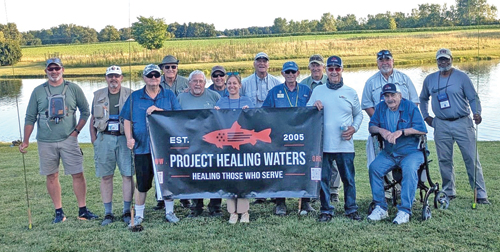
Photo caption: Participants in the Project Healing Waters program are pictured with program leader Gary Kader, fourth from left; assistant program leader Richard Fox, eighth from left; and assistant program leader Les Ester, ninth from left. The woman in the middle volunteers with the program. Photo provided.