
BBH school lunch programs integrate hydroponic gardens to provide locally sourced foods
by Dan Holland
Students at Brecksville-Broadview Heights High School and Middle School are not only receiving new lessons in ecology but also better school lunches thanks to a new program that uses vertical hydroponic towers to grow fresh produce served in school lunches.
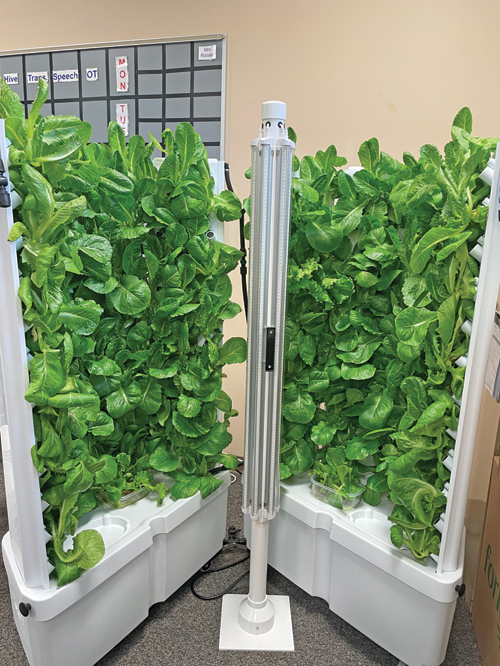
Two vertical hydroponic towers, provided by funding from the Skuza Foundation, were installed at the high school two years ago. A single tower, purchased by the school food service department, was installed in the middle school cafeteria last school year.
The towers utilize a stacked design with a closed-loop water system to grow plants without the use of soil. Produce grown with the system has included lettuce, basil, cilantro, parsley, thyme, cucumbers and tomatoes.
Both staff and students are involved in the use of the systems.
“The students at the high school who tend to the towers are special needs students, and they work closely with the teachers,” explained BBH Food Services Supervisor Amy Voigt. “At the middle school, a couple of our teachers in the science department took over the program, and their students do the daily maintenance of it. All students involved will take the pH of the water to see if more nutrients need to be added depending on the levels to have the right concentration. That’s done two or three times a week.”
Voigt explained that students plant the seedlings in a “rockwool” in which they sit under fluorescent light for two weeks. Once the plants begin to sprout, they are then transplanted to the towers, where they take approximately one month to grow before being harvested.
“The students have a hand in the entire process from start to finish; from planting the seedings to transplanting them, to checking the pH balance weekly, adding more nutrients, then harvesting when the lettuce and herbs are ready,” said Voigt. “They clean after every harvest, with a deep clean performed during Christmas, spring and summer breaks. They try to plan for the harvest around those times and give everything a complete scrubbing.”
The Flex Farm hydroponic growing systems are manufactured by Fork Farms, which provides detailed instructions on their usage.
Lettuce harvested in the system is the most commonly used crop in school lunch programs.
“It provides a local source of lettuce, which is especially important with the recent [cyclosporiasis] outbreaks with certain lettuce products,” said Voigt. “You can’t get more local than growing and harvesting the products right in the school building. So, if we have students who care about the environmental impact, that’s a benefit.”
Voight said an additional benefit is that the hydroponic lettuce tastes better and stays fresh much longer.
“It lasts in the cooler for two to three weeks and has a longer shelf life than what you buy in a grocery store,” she continued. “We have our tower at the middle school right in the serving lines. So, there’s an eye appeal when the students are walking in, and it’s something to be talked about, with students getting excited about that. So, it’s a full circle.”
Locally sourced foods
The school district partnered last year with Windy Way Farms in Massillon to procure a local source of beef.
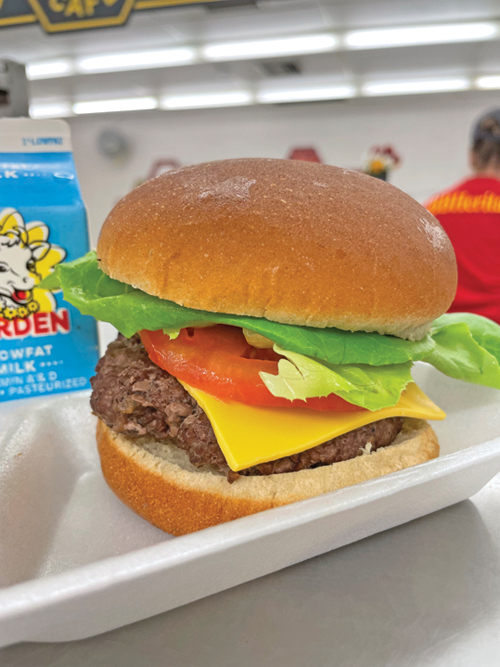
“Last year, one of my goals for the district was to purchase a cow and procure it and send it off and have burgers from a local farm, and we did that in October,” explained Voigt. “We did a whole local menu takeover in October, as it was farm-to-school month and national school lunch week, and that was an incredible project that we got very good feedback on.”
The district has also partnered with Bonner Farms in Garrettsville, from which raw beef patties are purchased through a distributor. The school lunch program’s pizza dough, cookies, breakfast bars and pizza bagels are also locally sourced.
Voigt is currently in discussions with Purple Sky Farms in North Royalton and Crown Point in Bath to purchase various fruits and vegetables on a large scale.
Procuring fresh, locally sourced produce is a goal of the program and partnerships.
“I enjoy the local partnerships and having the connection and supporting their small businesses,” said Voigt. “You can bring it into your district and teach your students about it, and let them know how it was grown within 15 minutes from here. They can understand that you don’t have to get all of your produce form faraway states — it can be done right here in Northeast Ohio.”
In addition to providing fresh products for school lunches, Voigt said the program sparks discussions within families.
“If the students are excited about the program, I hope that maybe the parents would be too,” said Voigt. “We live in a community that is cognizant of where our food is coming from and what the source is. So, I would hope if the parents see this on our menu, that they can have a conversation with the students about where it is grown. And, when students are coming through the lunch line, we have signs that let them read all about it.”
Photo caption: Two hydroponic towers installed at Brecksville-Broadview Heights High School in 2024 have been growing fresh lettuce for lunches served in the school’s cafeteria throughout the school year. Another tower was installed at BBH Middle School last school year. All three units allow special needs students learn how to grow and maintain the plants. Photo submitted.