
Social justice drives Crown Point’s community partnerships
by Karen Nathan
After starting several new initiatives, Crown Point Ecology Center Executive Director Ian Roberts is following through on his goal of building Crown Point into a community hub and a support for marginalized and underrepresented communities.
The ecology center has partnered with Vulnerable Voices, an organization supporting and advocating for African farmers living in Northeast Ohio. Roberts didn’t know the group existed but said, “the stars aligned,” when Andrzej Czarniecki from Central State University Extension showed up at his door earlier this year.
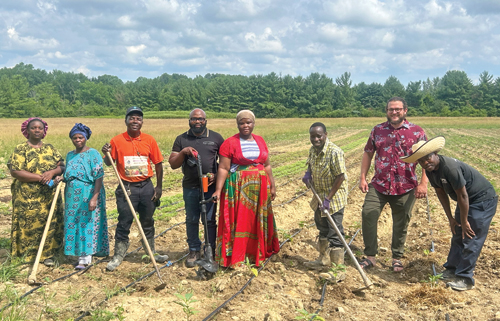
Czarniecki said he was working with a group of Africans looking for land to farm. Roberts offered Vulnerable Voices 11 acres of farmland not under production by Crown Point.
Omari Etando, Pela Abumba and Dieudonné Simbi, all refugees from the Democratic Republic of Congo, founded Vulnerable Voices in 2023. Etando landed in Buffalo 10 years ago and eventually made his way to Cleveland, where he plans to lay down roots.
There are many Africans living in Cleveland, Etando said, and Vulnerable Voices’ farmers hail not just from Congo but also Burundi, Tanzania and Uganda. All are fleeing “war, violence or human rights violations based on race, religion, nationality and political opinion.” All are legal, permanent residents.
Most are farmers, and their goal is to preserve and continue farming life in America. Several, like Kasigwa Rugenyeka, tried to farm in their miniscule inner city backyards. In Rugenyeka’s case, his landlord said “no.”
Vulnerable Voices’ collaboration with Crown Point allows farmers to cultivate the land and grow native African crops to feed their families and sustain their communities. The farmers want to expand beyond selling to the African community to provide much-needed income.
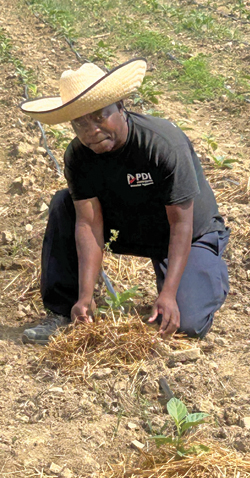
Farmers are working five of Crown Point’s 11 acres this summer. They are attempting to grow a variety of African plants like white eggplant, cassava, sweet potato leaves, amaranth (a spinach-like leafy green), African maize and Trinidad Moruga scorpion peppers. Northeast Ohio and Africa are disparate climates, so it is unclear how well the traditional African crops will do. In response, farmers were introduced to American crops including corn, peas, lettuce and celery.
There have been several other challenges as well. While Congo is a “paradise of animals,” Rugenyeka said they don’t eat the crops. However, in the U.S., deer and rabbits see the crops as a buffet, and the farmers need a deer fence. Presently, farmers are tilling the land with hand tools, so tractors would be helpful. The farmers are also seeking funding to address water pressure and irrigation issues.
Transportation, however, is the biggest barrier. Most of the farmers do not drive. They are hoping to raise money for a 15-passenger van and driver. Crown Point plans to help by hosting an African farm-to-table fundraising dinner this fall.
“Farming is everything to me,” said Rugenyeka, noting that working the land is part of an exercise routine that helps the African farmers combat stress, diabetes and cholesterol issues that are common for their people.
Etando said that most of the farmers, their wives and children do not speak English. Vulnerable Voices reads and translates letters; helps refugees apply for jobs; and interprets at school, work and appointments. We are “proud of being called refugees,” Etando said.
Local support
On a local level, Crown Point has partnered with Revere Schools’ special needs program. Twice a month, students with a range of abilities come to the center to learn animal husbandry and work in the gardens. Revere staff and aids work hand-in-hand with Roberts and Crown Point employees.
Participants are also exposed to Farming with Friends, a program that works with adults with disabilities, and learn how they can parlay their experience into a paid position with them or another agricultural endeavor.
Through feeding and caring for farm animals, kids learn that being a chicken farmer, for instance, could be a job. Other times, animals like goats and pigs simply provide emotional support.
Last school year Revere students planted 1,000 plants for Crown Point’s plant sale and prepped produce. This year, they elected to harvest produce specifically for Stewart’s Caring Place food pantry, another partnership Roberts pursued.
Roberts reached out to Sarah Vojtek, president and CEO of Stewart’s Caring Place, a facility offering support to those affected by cancer. Crown Point diverted surplus food from its Community Supported Agriculture program to the facility’s food pantry.
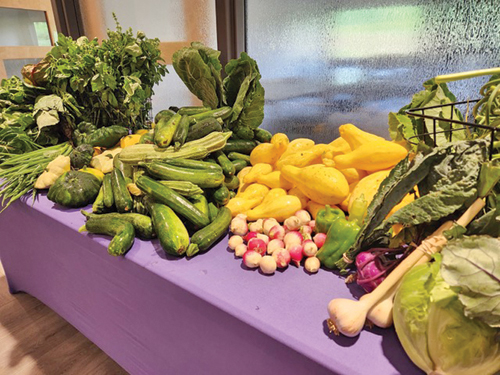
Vojtek sends out a weekly email to those utilizing Stewart’s resources to notify them when produce arrives. Invariably, it is all picked up before the end of the day. “We thrive on these collaborations and people like Ian make it all the more easy,” she said.
Crown Point and Stewart’s Caring Place are finalizing details for a family day where participants will come to the farm, harvest crops and then return to Stewart’s and work with their chef to cook a meal.
“We’re looking at bringing in other partners to make sure we’re living our mission of social justice, and combatting food insecurity,” said Roberts. “We can change lives by doing what we do.”
Photo caption: The Vulnerable Voices program, an organization supporting and advocating for African farmers living in Northeast Ohio, has several farmers growing crops at Crown Point Ecology Center to sustain their communities and earn income. Photo by Karen Nathan.