
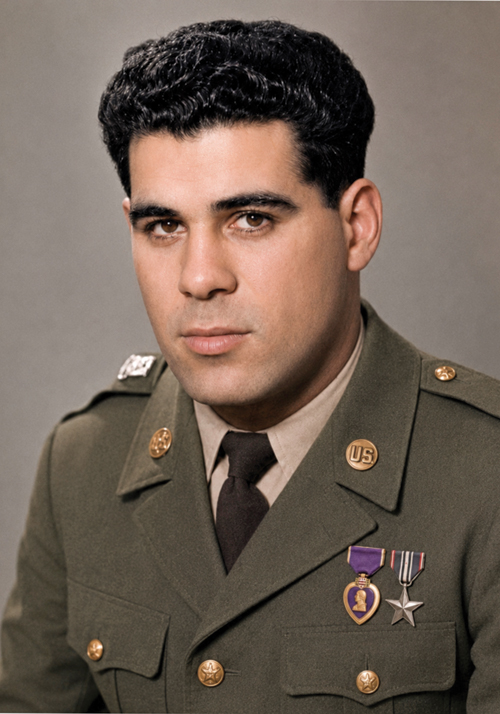
Recalling a Richfield war hero
by Sheldon Ocker
Joseph Tedesco is remembered in memorials on the lawn in front of Olesia’s Taverne of Richfield and in a banner attached to a utility pole near the old Richfield Town Hall.
But mostly, Tedesco’s bravery as an Army sergeant lives on in the memory of his daughter Sue Tedesco, who believes his story is worth telling, even if her dad was reluctant to talk about his sometimes harrowing experiences in the Korean War.
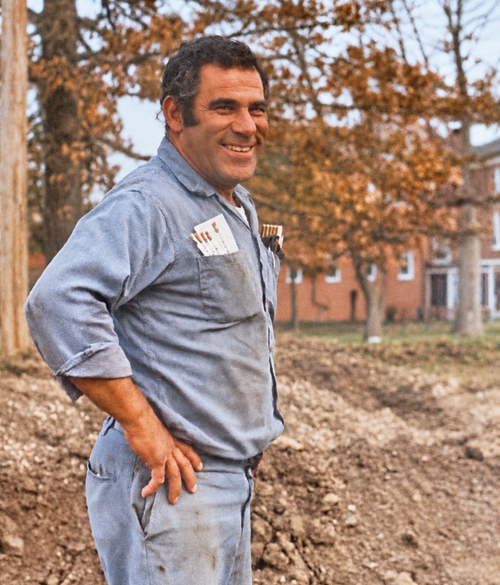
Like many soldiers who have seen combat, Tedesco was reticent about sharing his life in the infantry that pushed him to his limits, earning a Silver Star for valor in combat and three Purple Hearts for the wounds he suffered.
“Shortly before he died, he told us a couple stories,” said Sue, “but when we asked my mom why he didn’t ever tell us any of this stuff, she said he just didn’t talk about it.”
Sue Tedesco said her father grew up in a small Pennsylvania coal-mining town near the West Virginia border. One of six children, Joseph had no desire to follow in his father’s footsteps.
“He decided when he was very young that he did not want to be a coal miner,” Sue said. “So when he was 16, he joined the Merchant Marine and after two years he enlisted in the Army.”
Tedesco spent 10 years in the military, save for a brief time in 1950, when he was discharged, then re-upped for another six years, reaching the rank of sergeant first class.
He was awarded the Silver Star and a Purple Heart as a result of his actions on Oct. 14, 1951, near Mundung-Ni, North Korea.
Reading from the Army commendation, Sue said, “During an attack on a well-fortified and strategic hill, Corporal Tedesco displayed dauntless courage and cool behavior before the enemy despite intensive and hostile small arms automatic weapons and grenade fire.”
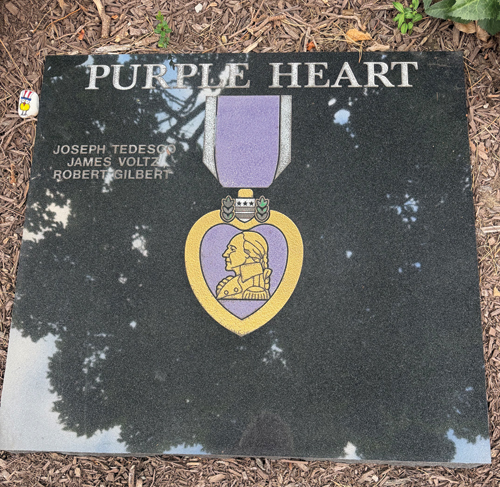
Tedesco led his men toward enemy positions but was “knocked down” by a grenade burst. He got back up and “inflicted many casualties” on the enemy.
On another occasion, Sue said Tedesco was captured by the North Koreans, who began marching him across a bridge.
“He thought, ‘This is it, they’re going to kill me or torture me,'” she said. “His men were in the jungle [beneath the bridge]. Somebody whistled, and somehow in his mind he knew that was a signal to him to jump off the bridge.
“When he heard the whistle, the North Koreans looked to one side to see what that was. He jumped off the other side of the bridge and kept running. They started shooting at him, but he got away, even though he was wounded.”
During another firefight, Sue said Tedesco carried five or six wounded soldiers to safety.
He spent much of his postwar military time in Austria, where the Army assisted in rebuilding many of the cities after the conflict in Europe.
The Army taught Tedesco construction skills, which he used when he settled in Richfield and worked as an excavator until a back injury forced him to retire.
When he was in Austria, Tedesco met Sue’s mother, Trudy, whom he married in 1954.
“My mom was selling anniversary clocks on the street in Salzburg,” Sue said. “He didn’t want an anniversary clock, but he bought one, anyway. I think he saw a pretty girl, so he bought one of her clocks.”
The tradition of service has continued in the Tedesco family: Two of Sue’s four daughters joined the Navy.
Photo caption: Joseph Tedesco (far right) is celebrating with fellow soldiers including the man beside him whose life he saved in the Korean War. Photo submitted.