
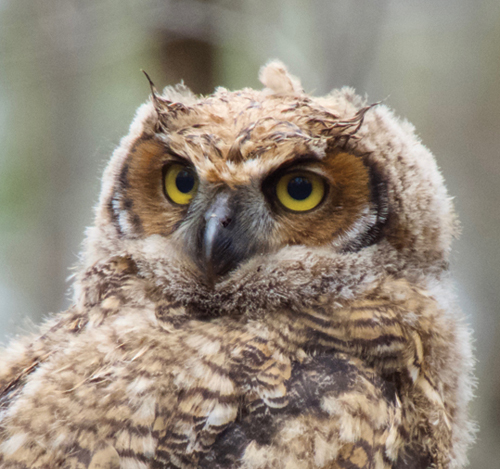
Owl ears: A guide to the Brecksville Reservation’s great horned owls
by Adriana Gasiewski
Throughout the year in the Brecksville Reservation, and not just during the “owl-tumn,” owls can be seen soaring above and into mosaic fields, large landscapes with diverse plants and the ecosystems inhabiting them.
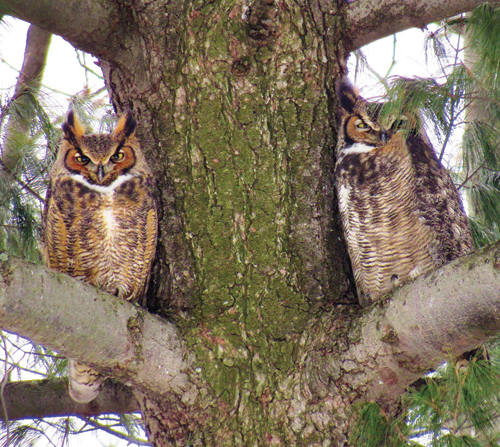
However, great horned owls, with their feather tufts standing tall on top of their heads, tend to stand out among the other owls that call the Brecksville Reservation home.
Jen Brumfield, a naturalist for the Cleveland Metroparks, said great horned owls are the third-most prevalent owl species to call the Metroparks home, making it important to understand that there’s nothing to fear about these raptors.
Being birds of prey, owls have earned the raptor classification because of their carnivorous eating habits. Unlike other carnivores, however, great horned owls hunt mice and rabbits.
“They can hunt large insects and snakes, so they really are adaptable in the food varieties that they will take,” Brumfield said. “When they’re hunting, [they’re] completely nocturnal so they’re out at night. That’s when the great horned owl is most active.”
In addition to being nocturnal, great horned owls also have extra light receptors in their eyes, enabling them to hunt in pitch-black darkness, she added.
“Their retinas are loaded with special rod cells that are upwards of 30 times more sensitive to light than human eyes,” Brumfield said. “So, what that means is their huge eyes are able to bring in extra light that our eyes are not able to, which is how they can see at night.”
Because of their disc-shaped face, owls have a teddy bear-like appearance. However, this unique face shape also helps funnel sound toward their ears.
A misconception about great horned owls is that their feather tufts function as ears. Instead, their tufts camouflage them and aid them in communicating with other animals.
Even though they’re an apex predator, great horned owls still must be on the lookout for hawks and eagles, so when they’re defending themselves, their tufts are raised high, according to Brumfield.
Like humans, owls have ears on the sides of their head, but their ears are asymmetrical, meaning one ear is higher than the other.
“Their hearing is just extraordinary. In the dead of night, they can hear a mouse rustling through leaves on the forest floor or out in a field,” Brumfield said.
Because of their hunting skills, great horned owls have earned the nickname tigers of the forest.
During the day, they rest in their roosts, daytime resting places for owls. Their roosts can be found either in dense white pine trees or dense white cedar trees.
Owls only use nests for nesting or raising their young. Great horned owls also don’t make their own nests, as they opt to move into a vacant red-tailed hawk nest instead, Brumfield explained, noting that typically, great horned owls move into empty nests during January and December so their eggs can hatch 30 to 36 days later.
“By then, it’s becoming more and more springtime, mammals are getting more active and birds are getting more active,” Brumfield said. “So, by the time their young have started to get larger and larger, there’s more and more food to find for them on the landscape.”
Because of their ability to adapt to Ohio’s weather and their abundance of food, local owls don’t migrate south during the winter.
Another fact is that contrary to popular belief, owls can only turn their head upward of 270 degrees, not 360 degrees.
Owl-though it can be enticing to observe great horned owls, Brumfield emphasized people must follow birdwatching etiquette and respect when approaching them.
When walking toward an owl, try to be quiet to avoid disturbing them and don’t spend too much time observing them, Brumfield said, as the stress of being watched will cause the owl to be too hypervigilant.
“We need to be highly respectful that when we go to hike in reservations, we are in those animals’ homes,” she said. “That is where they live, that is where they are flourishing, that is where they are safe and that is where they raise their young.”
Photo caption: Great horned owls are prevalent throughout the Brecksville Reservation. Photos submitted by Jen Brumfield.