
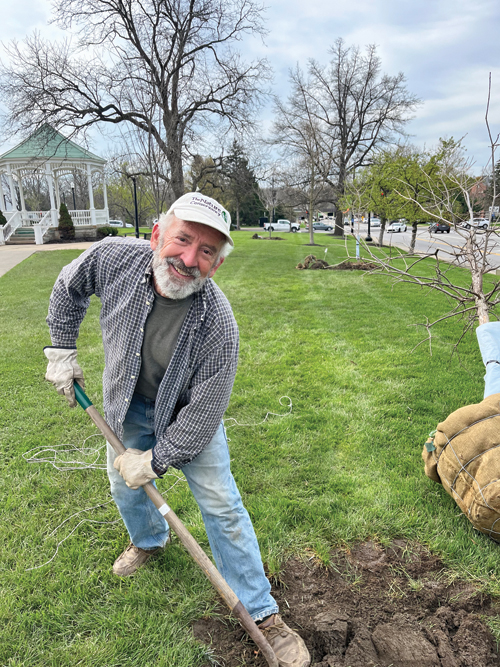
Curt Van Blarcum honored for decades of reshaping Hudson’s landscape
by Judy Stringer
Curt Van Blarcum is rarely at rest. The longtime conservationist has designed landscapes, restored wetlands, built walking paths, protected historic trees, educated students on environmental stewardship and even rescued a historic barn to serve as a community learning center.
More often than not, he is knee-deep in the dirt, hauling saplings, digging holes, watering plantings and spreading mulch across Hudson, where Van Blarcum has planted hundreds of thousands of trees and shrubs over the last two decades.
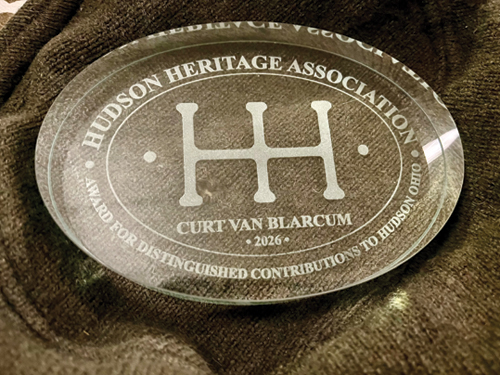
This relentless, hands-on dedication to the natural world recently earned Van Blarcum the Hudson Heritage Association’s Distinguished Contributions to Hudson Award, an elite recognition he shares with just four other local luminaries: Tom Vince, Ginger Rogers, Pat Eldredge and Katie Hoy.
HHA board member Diccon Ong noted in presenting the honor that the community could ask for “no more fitting addition to that pantheon than Curt Van Blarcum.”
“In 1994, he became Hudson’s first city arborist,” Ong told the crowd at HHA’s annual meeting. “And from that point forward, it becomes very difficult to tell the story of Hudson’s landscape without, at some level, telling the story of Curt.”
As city arborist, Van Blarcum was charged with caring for Hudson’s trees, performing field inspections, reviewing development plans, applying for forestry grants and enhancing the natural canopy. In 1996 alone, he oversaw the planting of 751 trees across the community.
He later spent 16 years as director of grounds at Western Reserve Academy, where he established commemorative groves and served concurrently as a landscape architect, contractor and caretaker of “everything that was outdoors” on a campus known for its sweeping green lawns, meticulously kept grounds and historic, park-like beauty.
Today, Van Blarcum provides commercial and residential arboriculture services through his business, Curt’s Trees, while continuing his civic initiatives. When the Hudson Garden Club sought to add to the Gazebo Green canopy with a line of trees that will one day shade Bandstand Summer Concert audiences, it was Van Blarcum who sourced and planted the trees.
He is also the driving force – and primary workhorse – behind an ambitious effort to transform the Hudson School District’s once sparsely vegetated schoolyards into what he calls “living layered landscapes.” The idea came to him while walking around Hudson High School a few years ago.
“When I looked up, I saw this ribbon of excellence, and I thought, ‘If we could do that academically, why can’t we do that with the grounds? Why can’t we have extraordinary grounds?'” Van Blarcum said.
ReGreen revolution
To turn that vision into reality, he partnered with Hudson City School Board member Tom Tobin to launch “ReGreen Hudson Schools.” Fueled by grants and community donations, the privately funded initiative reimagines campus environments across the district.
Projects to date have included revitalization of the 50-year-old Reinhart Arboretum at McDowell Early Learning School, where invasive species were removed, dead trees were cleared, a pond was reestablished and 150 new plants and trees – spanning 53 different species – were added to the space.
“We also opened up a loop trail that was previously impassable and surfaced it with wood chips,” he said. “Now it’s actually wheelchair accessible, because … an important part of what I do is to make sure everyone can get out there and appreciate and observe what nature does for them.”
The arboretum currently serves as a bustling outdoor classroom where kindergartners stomp around in mud boots and get their hands dirty during “Forest Fridays.”
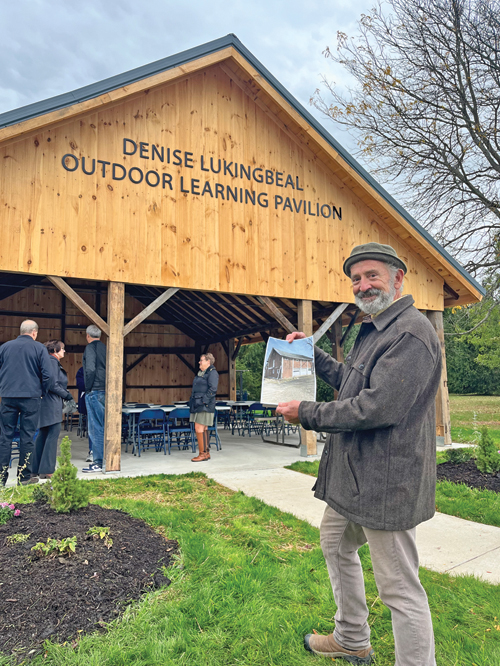
Two miles away at Ellsworth Hill Elementary School, Van Blarcum’s vision takes on an even larger scale. There, he planted an apple and cherry orchard, guided the construction of a 130-foot boardwalk stretching over local marshlands and led the effort to relocate and restore the historic Flood Barn as an educational pavilion.
When the 19th-century barn on Barlow Road faced imminent demolition, Van Blarcum chaired an HHA subcommittee that worked with the school district to dismantle, move and reassemble the barn’s vintage timber not as a “four-walled structure,” he said, but as an open-air pavilion.
“I think the kids really love having that space,” Van Blarcum said, “and my hope is that the barn can go on to serve the community for another 150 years.”
Beyond these centerpiece projects lies a quieter layer of Van Blarcum’s influence. Newly established rows of redwoods and black gum trees at East Woods Intermediate, for example, obscure the view of its parking lots from neighboring homes. Once mature, these trees will also shield the asphalt from the sun’s blistering rays, keeping the campus cooler and sparing teachers from returning to sweltering cars on sunny days.
Nearby, hundreds of native prairie grasses, perennials and spruce now complement a stormwater detention basin, absorbing and filtering runoff from the parking lots while providing a natural habitat for local wildlife.
And, just this fall, Van Blarcum planted 18 large evergreens between Lavelli Field and Hudson Middle School. While the new evergreens perform the immediate purpose of wind buffering and visual screening, he sees every landscape addition through a much wider lens.
What looks like a simple row of trees is actually a carefully calculated effort to stretch limited resources into a lasting community asset.
“In the conservation world, you rarely work with big money,” Van Blarcum admitted. “My focus is always on making a $4,000 or $5,000 investment go as far as possible, creating visual, ecological, social and economic value. … Something as simple as letting kids gather in the shade of a healthy, diverse landscape can transform their daily experience.”
Photo caption: Curt Van Blarcum holds a photo of the historic Flood Barn, formerly located on West Barlow Road, while standing in front of the Denise Lukingbeal Outdoor Learning Pavilion at Ellsworth Hill Elementary. The pavilion was constructed out of salvaged 19th-century timbers of the original barn.