
Trustee’s Corner Paul Schweikert
I attended the Northeast Ohio Regional Sewer District’s Suburban Council of Governments meeting in early June. A projection of costs was given over the next five years. The sewer rate will increase 2% annually from 2027-2031.
Your sewer bill is based on water consumption per MCF (1,000 cubic ft. of water). One thousand cubic feet equals 7,480 gallons of water used. The typical usage is 3,740 gallons of water a month, or 0.5 MCF.
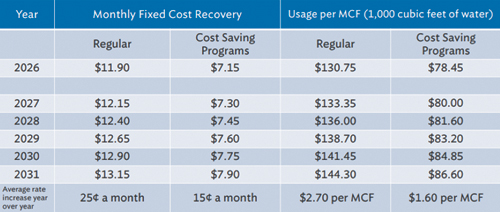
The 5-year rate schedule is outlined in the chart shown. It is also available on the sewer district’s website at neorsd.org/rates.
There are 62 communities in the Suburban Council of Governments. Every community is part of the project cost depending on what tier they are in. Sagamore Hills is in Tier 3 along with Macedonia, Northfield Village, Hudson, Village of Richfield, Walton Hills and Brecksville.
Wastewater fees collected are based on a fixed fee plus charges based on consumption, and used towards wastewater treatment and wastewater projects.
Where does your sewer money go? Since the start of Project Clean Lake in 2011, the sewer district’s goal has been to reduce combined sewer overflows from 4.5 billion gallons to 494 million gallons annually, with 78 total projects to be complete by 2036. The entire sewer district has 344 miles of regional sewer pipes, three wastewater treatment plants and 489 miles of regional stormwater system requiring continual maintenance.
Currently, a portion of your wastewater dollars are being spent on the sixth of seven tunnel construction projects, which have a completion date of 2031. The tunnels store combined sewage until it can be treated at a wastewater plant, instead of flowing directly to the environment and eventually Lake Erie. The Southerly tunnel project costs $348 million to control 760 million gallons of combined sewer overflows discharged to the Cuyahoga River in a typical year. There will be an associated dewatering pump station built with a completion date of 2030, at a cost of $78 million.
The stormwater rate will increase 4% in 2027 and 2028, followed by a reduced increase of 3.5% in 2029, 2030 and 2031. Under this proposed rate structure, the average total impact on customers is just under $3 a month annually over the five-year rate cycle.
Stormwater fees are collected from three tiers of fixed charges based on the square footage of impervious surface area on each parcel. Fees are used for regional stormwater management program projects and maintenance.
Sewer and stormwater charges can both be lowered if a customer is eligible for any of the sewer district’s cost-saving programs. An example of the impact of rate reduction is shown in the sewer rate table in the “cost saving program” column. Additional rate information, resources and cost-saving program links are available at neorsd.org/rates.
The Suburban Council of Governments realizes most people do not care for any cost increases. The Northeast Ohio Regional Sewer District CEO Kyle Dreyfuss-Wells has been a good steward of trying to keep increases to a minimum. Wells has been the most transparent leader of the sewer district to date. If you have any questions, I can be reached at 330-467-4970.
Photo caption: This chart shows the five-year pricing structure for sewer services. Photo submitted. S-Trustees-Schweikert.jpg