
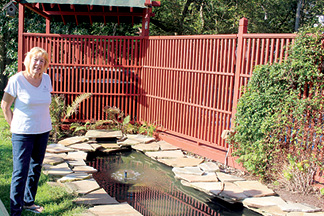
Hinckley helps Medina become first county in Ohio certified as a Community Wildlife Habitat; Celebration planned for Oct. 21 at Buffalo Creek Retreat
by Erica Peterson
Medina County is the first county in Ohio to be certified as a Community Wildlife Habitat by the National Wildlife Federation. The county has several Hinckley yards and gardens to thank for helping it qualify for the designation.
According to Linda Schneider, education coordinator with Medina County Soil and Water Conservation District, the county hit the magic number of 400 certified wildlife habitats in yards, schools and community gardens.
NWF staff will present the certification to county commissioners at a celebration set for Sunday, Oct. 21 at Buffalo Creek Retreat from 2-4 p.m. Vendors, speakers and activities are planned for the event.
Certification requirements
In order for a backyard or garden to be certified, gardeners need to demonstrate that food, water, shelter and places for animals to raise their young are available and that sustainable practices are being used.
Those basics cover a lot of ground, Schneider said. As far as food, NWF is looking for more than just bird feeders.
“We’re talking about planting berry trees for birds to eat and nectar plants for the butterflies and other pollinators,” she said.
Water needs to be available “on all levels, from toad bowls to bird baths,” she said. Streams and ponds are helpful, too.
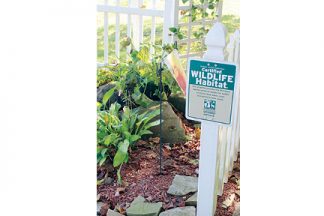
Shelter and cover can be provided through natural items, like trees and shrubs, and through manmade means, like creating brush piles, Schneider said.
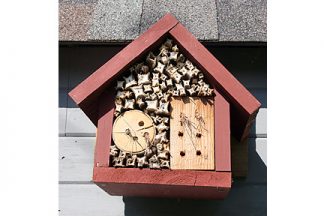
There are both natural and manmade choices for creating areas where wildlife can raise their young, from trees that provide cover and good branches for nesting to birdhouses and bee houses, she said.
Sustainable practices can include planting wildflowers and other native plants, as well as not using chemicals.
Certification by the NWF is on the honor system, Schneider said. It costs $20 and includes a sign designating a yard as a certified wildlife habitat.
“Your yard doesn’t have to be perfect,” Schneider said. “This is a process.”
Hinckley habitat
It’s a process that certainly pays off, if Connie and Bill Ogilvie’s yard is any indication. The Hinckley residents had their yard certified in 2014.
Birdseed feeders, hummingbird feeders, fresh fruit and bird houses can be seen all over their Center Road yard. There are five birdbaths, an aerated pond and plenty of trees, brush, flowering plants and gardens.
The couple has two rain barrels they use to water the property, another example of a sustainable practice. And they added two Mason bee houses this year.
Connie said she and Bill are a good team.
“He says he’s the back and the brawn, and I’m the picker and tell him where to plant what,” she laughed.
Connie became an Ohio Master Gardener in 2008, after she retired and had more time to devote to gardening. Her goal was always to attract animals to the yard by providing food, shelter and places to be safe, she said, so becoming a certified wildlife habitat was a perfect fit.
The Ogilvies have learned to co-exist with the wildlife that enjoy their gardens, like the deer. “Some of it is grown for us, some of it is grown for them,” Connie said.
They have a no-kill policy, she said. “Bill is not a fan of snakes, but if we find one, we just move it,” she said.
The payoff is worth it, she said, as they see everything from butterflies and hummingbirds to orioles, rabbits, raccoons and even a red fox.
“We are so grateful that we get to do this,” she said. “We feel blessed we have been given this opportunity.”
Planting for pollinators
While Schneider is pleased the county is getting recognized, she is more excited to see so many people like the Ogilvies recognize the importance of providing habitats for wildlife, especially for essential pollinators like birds, butterflies and bees.
“Grass is overrated,” she said. “People that have only lawns, that haven’t planted anything else, they are not supplying anything else necessary for wildlife to survive.”
And that is becoming more and more critical.
“We’re losing our monarchs, our birds,” she said. “We’ve never had this problem like we do right now, with species going extinct.”
Vanishing habitat is probably the No. 1 reason for the losses, Schneider said.
“We put our houses in their habitat,” she said. “We need to help the creatures that are in trouble, from tiny ones to much larger species that we are displacing because of our sprawl.”
Monarch butterflies are a prime example of a critical species that is vanishing, she said. Their annual migration, a 3,000-mile trek from Canada to Mexico, is the largest in the world. Schneider calls Medina County a “pivotal” stop on their trip.
“Our fields of goldenrod and asters are very important for fall fuel, a food source to get strong enough to fly all the way to Mexico,” she said.
If monarchs disappear, the effects will be far-reaching, Schneider said.
“Butterflies are like the canary in the coal mine,” she said. “If we’re having trouble with our smaller species, and we’re disrupting the cycle of life in nature, then humans are going to be in trouble, too.”
She hopes to see wildlife habitat certifications continue.
“We don’t have to stop at 400. There is room for plenty more,” she said.
Visit nwf.org for more information and to apply for certification as a wildlife habitat.
Featured image photo caption: Connie Ogilvie’s backyard has several examples of what a certified wildlife habitat should include, like water sources, nectar plants like clematis (at right) to feed pollinators, and places for birds to raise their young, like birdhouses (above Ogilive.) Photo by E. Peterson